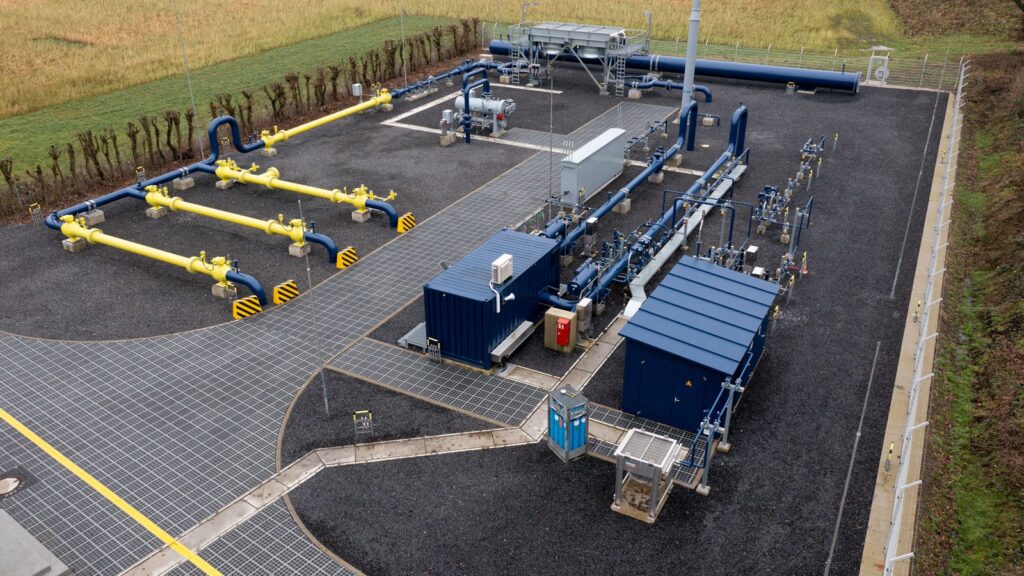
When CIOmove visits Uniper in March 2026, the focus will not only be on energy generation, but also on what happens next in the value chain. As Germany’s largest gas transmission system operator, Open Grid Europe (OGE) ensures that energy reaches industry and consumers safely, reliably, and affordably.
Ahead of the event, OGE CIO Ralf Werner shares how digital transformation, resilience, and digital sovereignty shape IT decisions in a highly regulated critical infrastructure environment.
Headquartered in Essen, OGE operates Germany’s largest long-distance gas transmission network, spanning around 12,000 kilometers. While Uniper focuses on energy generation, OGE is responsible for energy transport – a role that must function reliably at all times.
Today, this role is expanding. Alongside natural gas, OGE is preparing its infrastructure for hydrogen and CO₂. “That is our big mission for the next 15 years,” Werner explains. “We need to transport energy safely, resiliently, but also cost-efficiently – and that only works with technology.”
How OGE Structures Transformation Across Business, IT and Data
For Werner, digital transformation is inseparable from business strategy. OGE structures its transformation around a clear framework: a strategy house with the business as the roof, supported by people, processes, and technology, resting on data as the foundation. “With these five elements you can explain very well how everything fits together,” Werner says. This structure also creates the bridge to topics such as automation, digital literacy, and advanced analytics.
Economic pressure adds another layer of complexity. Rising infrastructure costs and long-term investment cycles mean efficiency has become a central responsibility. Werner compares pipeline infrastructure to railways or highways – except that OGE operates energy transport systems. “There is a lot of intelligence and mathematics involved to plan routes in a cost-efficient way,” he says.
When Physical Infrastructure Meets Digital Systems
At OGE, resilience goes far beyond classic cybersecurity. As infrastructure becomes more digital and decentralized, physical security, operational technology (OT), and cyber defense are increasingly converging. Today, OGE operates a proprietary control network that manages gas flows centrally and on premise. “There is no cloud in use today,” Werner explains. “It’s all on premise – it’s critical infrastructure.”
At the same time, OGE is working on building digital twins of its infrastructure in the cloud. The goal is not to control live operations from the cloud. “The idea is to build a digital twin of all these assets in the cloud, where you can run scenarios and simulations very efficiently,” Werner says.
Looking ahead, he describes a vision in which infrastructure components act as intelligent agents. “If an electrolyzer is an agent, if a compressor station is an agent, if a substation is an agent, then you can connect all of them and let them interact intelligently,” Werner explains. Human operators remain in control, supported by decision models and simulations.
Pragmatic AI in Daily Operations
OGE already applies AI where complexity and efficiency demand it, with a strong focus on practical value:
- Network control: “We have built something we call a ‘carbon guide’,” Werner explains. “You can ask it how to operate the network in a way that consumes as little CO₂ as possible.” The system provides recommendations, while final decisions remain with the dispatcher.
- Infrastructure inspection: OGE uses computer vision to detect anomalies during mandatory aerial inspections of pipelines. “The AI recognizes what should be there and what should not,” Werner says. In the future, this approach could be extended using drones and satellite systems, creating new inspection options.
- Knowledge management: With many experienced employees approaching retirement, OGE is working to make operational knowledge less dependent on individuals. “We are currently working on making critical operational knowledge more accessible across the organization,” Werner says.
Lessons from Energy Transport for CIOs
At CIOmove@Uniper, Ralf Werner will contribute the perspective of energy transport and infrastructure operations. The discussion will focus on how digital transformation helps manage complexity, ensure resilience, and support efficiency in systems where stability is critical.
Registration for the event
Please register for the event by sending an email to Claudia Michel.